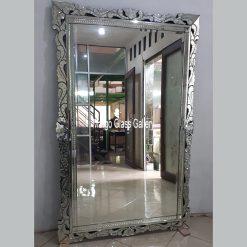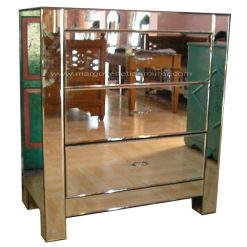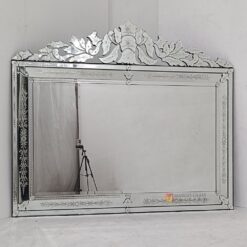
Antique mirrors and the Aesthetics of Post-Minimalism emerge as a new dialogue within contemporary visual and interior design an answer to the growing fatigue toward spaces that feel overly sterile and emotionally distant. For more than a decade, minimalism dominated visual discourse: clean lines, generous white space, neutral palettes, and objects stripped of expression. In its time, minimalism offered calm, clarity, and order. Yet over time, many spaces began to feel too empty, too quiet, and lacking emotional depth.
This is where post-minimalism enters not as a rejection of minimalism, but as its enrichment. Post-minimalism still values restraint, yet it opens space for detail, texture, history, and objects with strong character. Why does the antique mirror feel so relevant within this aesthetic shift? Because it introduces controlled visual complexity a gentle contrast that balances modern spaces without overwhelming them.
Post-minimalism can be understood as a stage of visual maturity. If minimalism is about reduction, post-minimalism is about selection. Objects are no longer present simply because they are minimal or absent because they are decorative; instead, each element is chosen for its emotional and visual resonance. In this context, an Antique Style Mirror is not merely nostalgic ornamentation, but a narrative element that enriches spatial experience.
Post-minimalism acknowledges that humans need visual detail to breathe details that are not noisy, but layered. It allows space for objects marked by time, including mirrors with antique effects that feel imperfect yet visually honest.
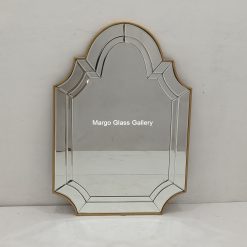
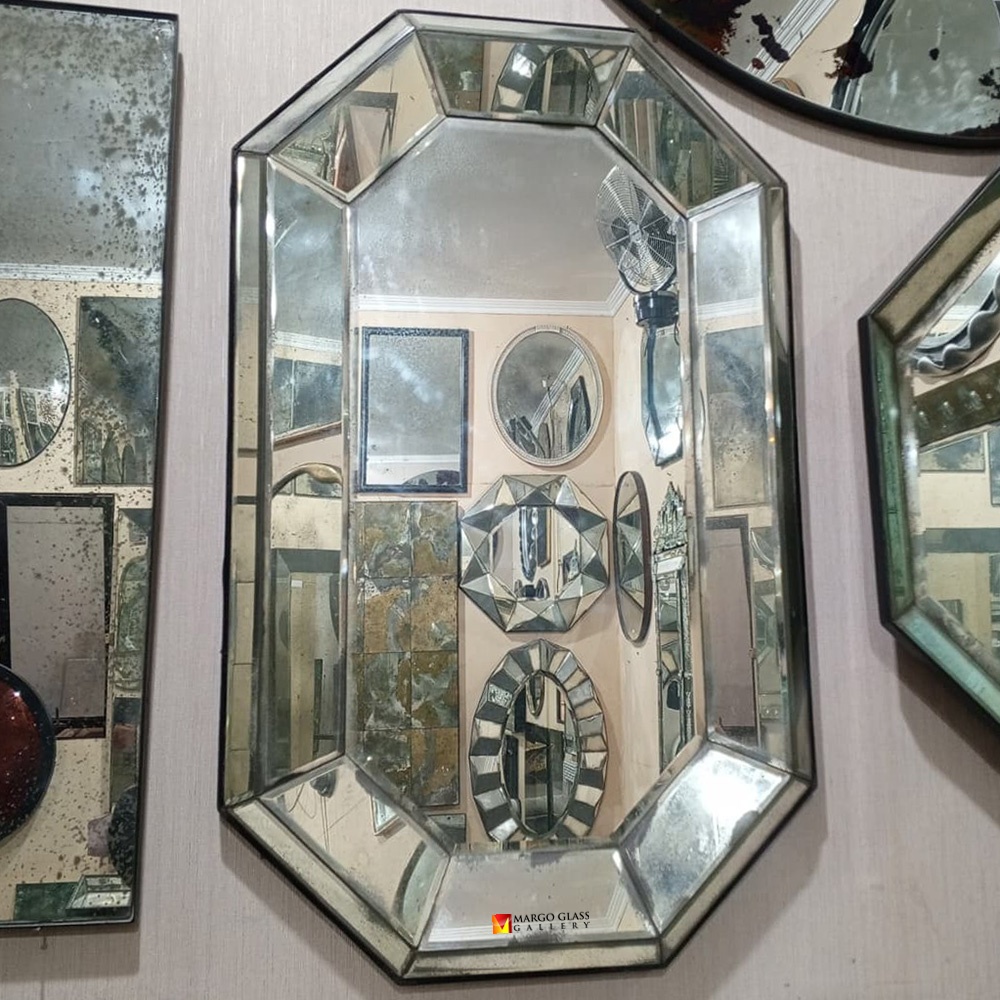
Within post-minimalist interiors dominated by clean surfaces and structured compositions, a Decoration Antique Mirror functions as a visual counterpoint. It disrupts monotony without disturbing harmony. Measuring 100 cm x 60 cm, this mirror is proportioned to act as a focal point while remaining visually balanced within the space.
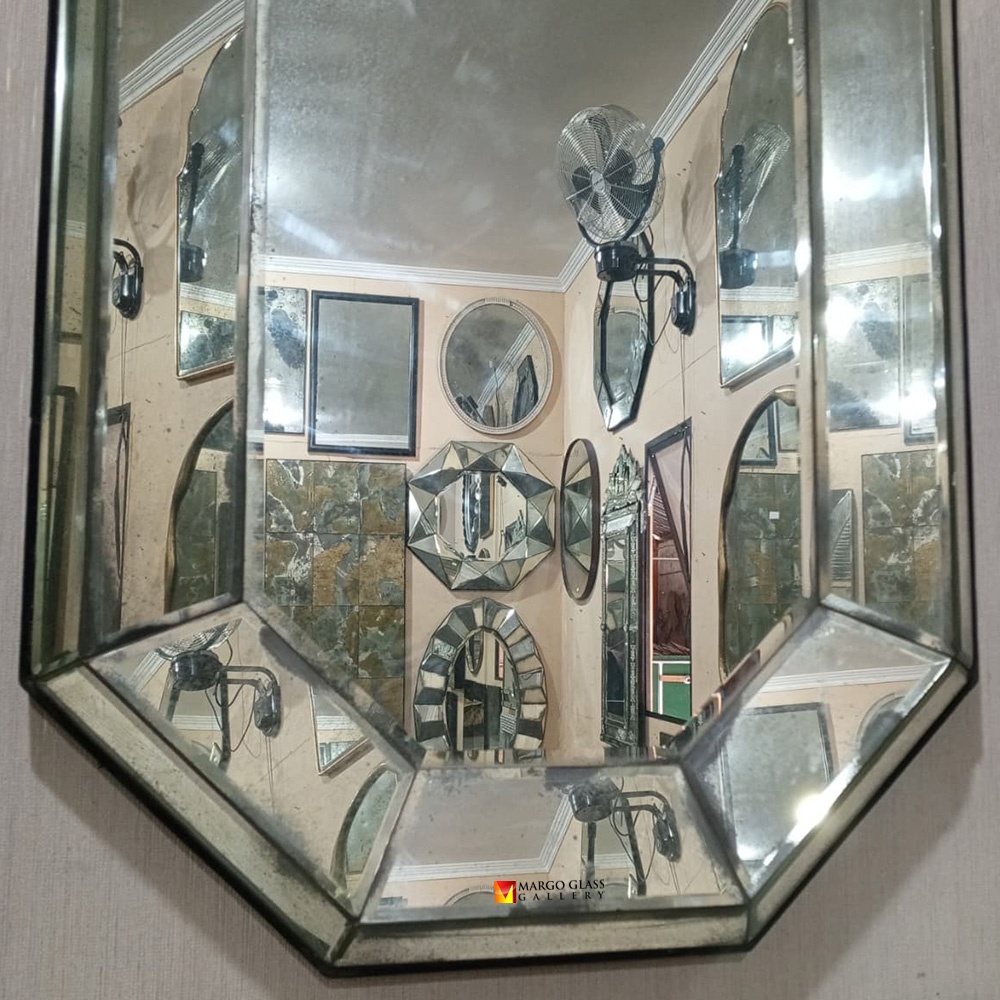
The reflection it produces is intentionally not crystal-clear like modern mirrors. Instead, the subtle patina creates a deeper, more atmospheric reflection. Isn’t it often true that reflections with distance and softness feel more emotional than those that are perfectly sharp?
One of this mirror’s strongest visual attributes lies in its Antique Mirror Octagonal design. The eight-sided geometry introduces architectural clarity without rigidity. Each beveled segment frames the reflection rhythmically, creating depth and a sense of spatial order.
In post-minimalism, complexity is never random. The octagonal frame demonstrates how rich detail can still feel controlled and intentional. It delivers visual depth without sacrificing spatial balance. Must a complex frame always result in visual clutter? Not when proportion and structure are guided by thoughtful design.
The Mottled Antique Mirror effect on the glass surface becomes a crucial visual language. Soft speckling, subtle tonal variations in silvery gray, and gentle patina introduce the narrative of time. No two reflections appear exactly the same and therein lies the appeal.
Post-minimalism celebrates imperfection as visual honesty. Crafted from 5 mm thick glass with an antique finish, this mirror remains functional while offering character and depth. The reflection is softened rather than harsh, creating emotional resonance within the space. After all, isn’t a well-designed room defined not only by what we see, but by what we feel?
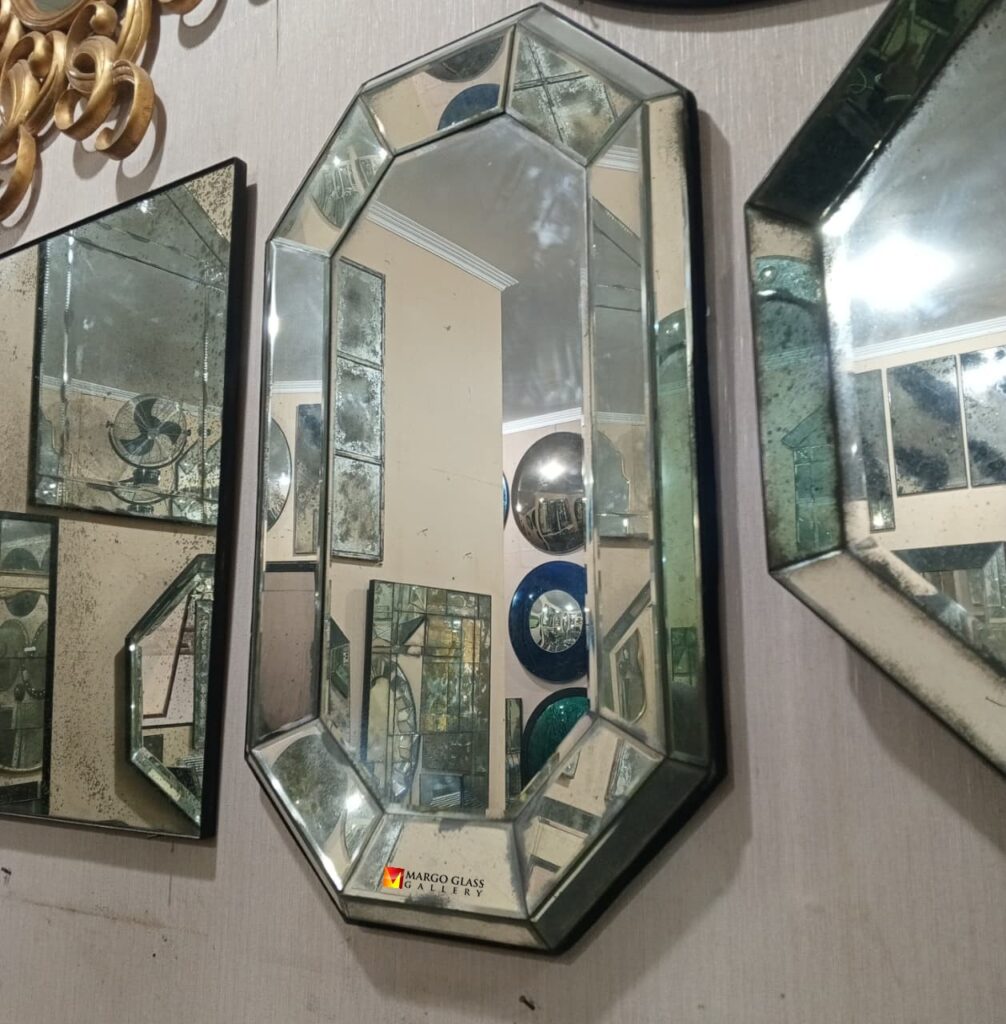
Despite its antique character, this mirror is not trapped in the past. Its back construction uses 18 mm plywood with a black finish, delivering a clean, modern, and structurally solid presence. This combination allows the mirror to integrate seamlessly into contemporary interiors whether in private residences, creative studios, or curated gallery spaces.
This is the essence of post-minimalism: historic objects placed within modern contexts. The antique mirror no longer functions solely as a symbol of nostalgia, but as a medium that connects history with contemporary design language.
In creative disciplines such as interior photography, editorial styling, and exhibition design, antique mirrors are often used as framing devices. Layered reflections, subtle distortion, and textured surfaces create narrative dimensions that standard modern mirrors cannot replicate.
Functionally, it remains a mirror. Visually, it becomes an exploratory medium. This is why designers and curators increasingly choose Antique Style Mirrors within post-minimalist approaches because they invite interpretation without demanding attention too aggressively.
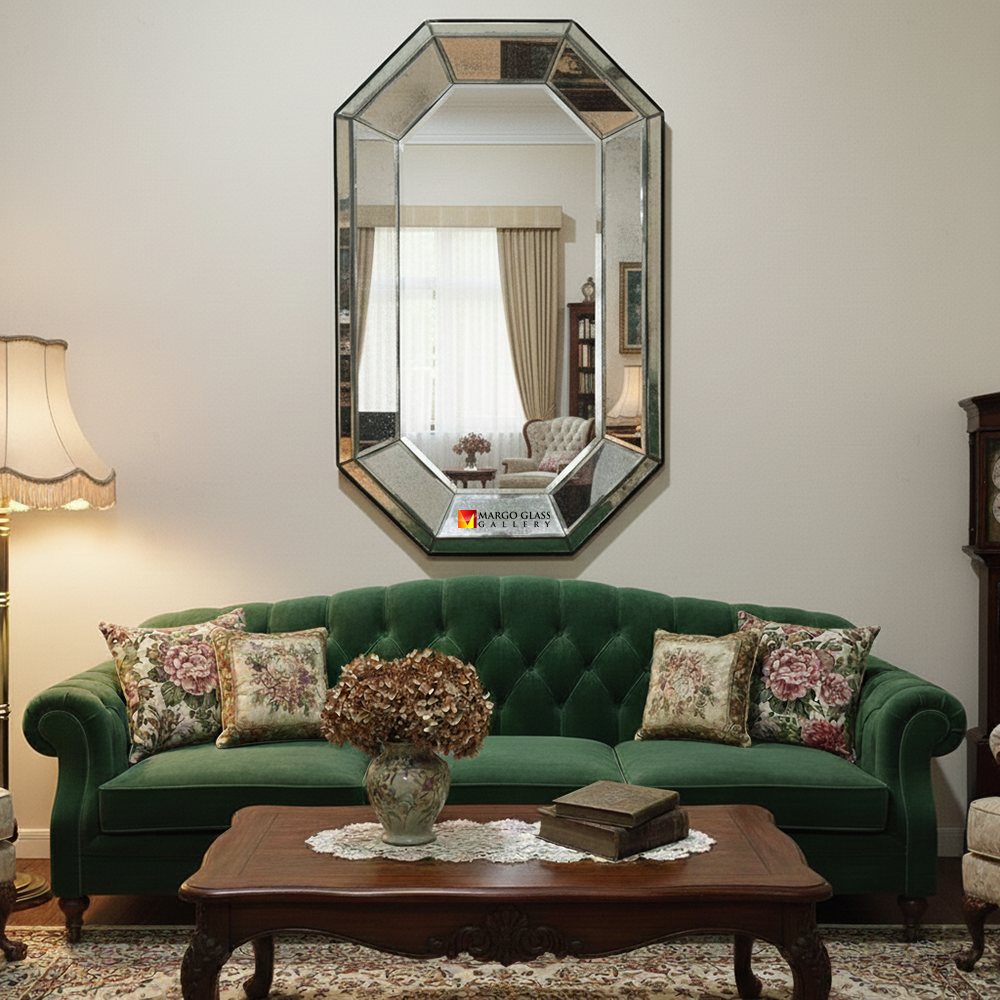
Post-minimalism gives permission for detail to re-enter the visual field not as distraction, but as balance. An antique mirror with geometric structure, textured neutral tones, and solid material construction exemplifies how detail can enrich without overwhelming.
Must a modern space always remain sterile to feel refined? Or does true visual maturity emerge when we allow character and history to coexist with clarity?
Within the Aesthetics of Post-Minimalism, complexity is not the opposite of simplicity, but a reflection of visual maturity. Antique mirrors act as balancing elements filling empty space with meaning rather than noise. They remind us that detail, texture, and traces of time can coexist harmoniously with contemporary design.
As an Antique Mirror Company, we believe that every mirror is more than a reflective object it is a visual instrument that shapes atmosphere. When you are ready to move beyond cold minimalism toward spaces that breathe, resonate, and carry layered meaning, this may be the moment to invite an antique mirror into your visual narrative.
By : Wulan
We are a leading manufacturer and wholesaler of Venetian mirrors in Indonesia. With our commitment to elegant design, superior quality, and competitive prices, we cater to individuals, wholesalers, and even large-scale projects such as hotels.
Whether you need advice on designs or sizes, feel free to consult with us. Let us be your reliable source for exquisite Venetian mirrors.