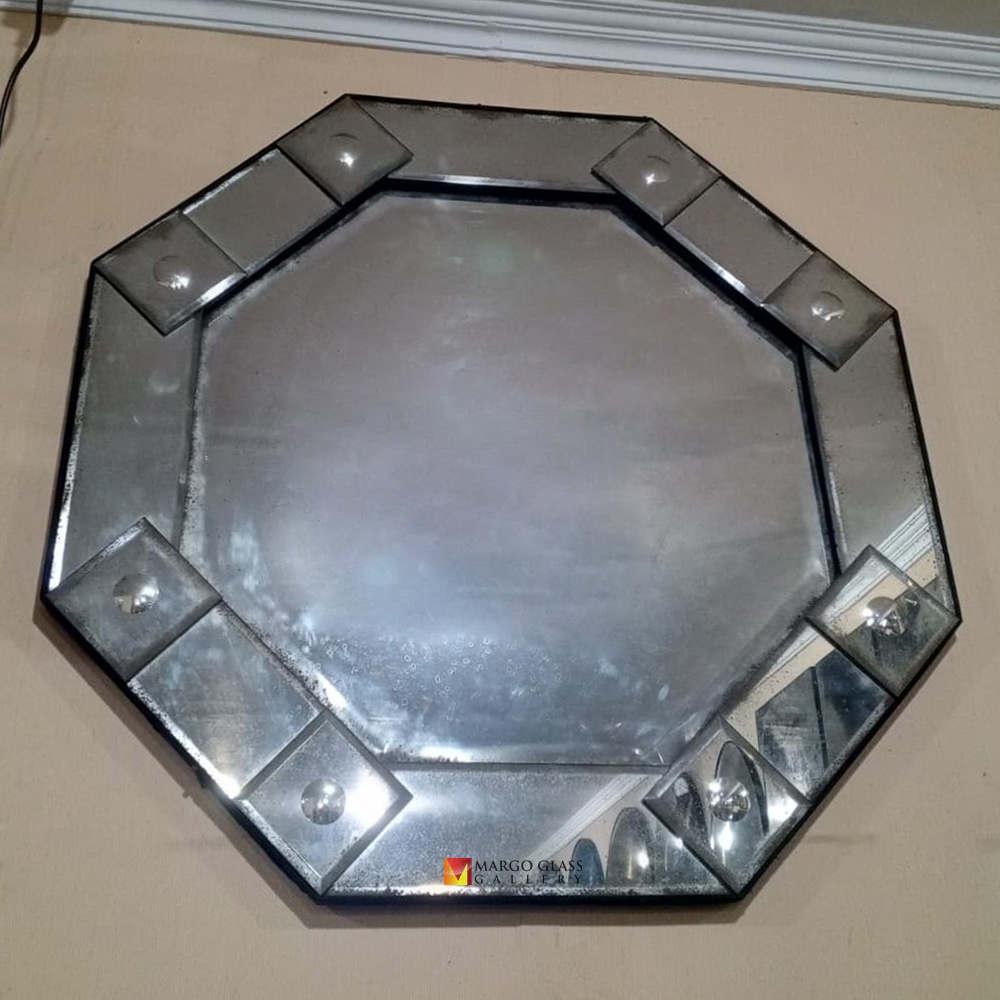
In the world of design and Visual Culture, the Octagonal Antique Mirror is often interpreted as a representation of Liminal Space in Visual Culture a space that exists in between, neither fully anchored in one state nor completely transitioned into another. Form is never truly neutral; every line, angle, and curve carries messages, emotions, and philosophies that shape how humans perceive space and themselves.
This is where the octagonal antique mirror emerges not merely as a decorative element, but as a visual symbol of thresholds a form that is neither entirely circular nor entirely square. Isn’t this “in-between” position one that we frequently experience in modern life?
As an Antique Wall Mirror, this piece occupies a unique conceptual territory: it reflects reality while simultaneously softening it. Its antique finish produces reflections that are not entirely literal, opening interpretive space for deeper contemplation of identity, time, and transformation.
The concept of liminal space derives from the Latin word limen, meaning threshold. In visual culture, liminality refers to transitional conditions moments when something is no longer fully what it once was, yet has not entirely become something new. Why has this concept become so relevant today? Because modern life is defined by constant transitions: shifting social roles, evolving lifestyles, and changing ways of experiencing and defining domestic space.
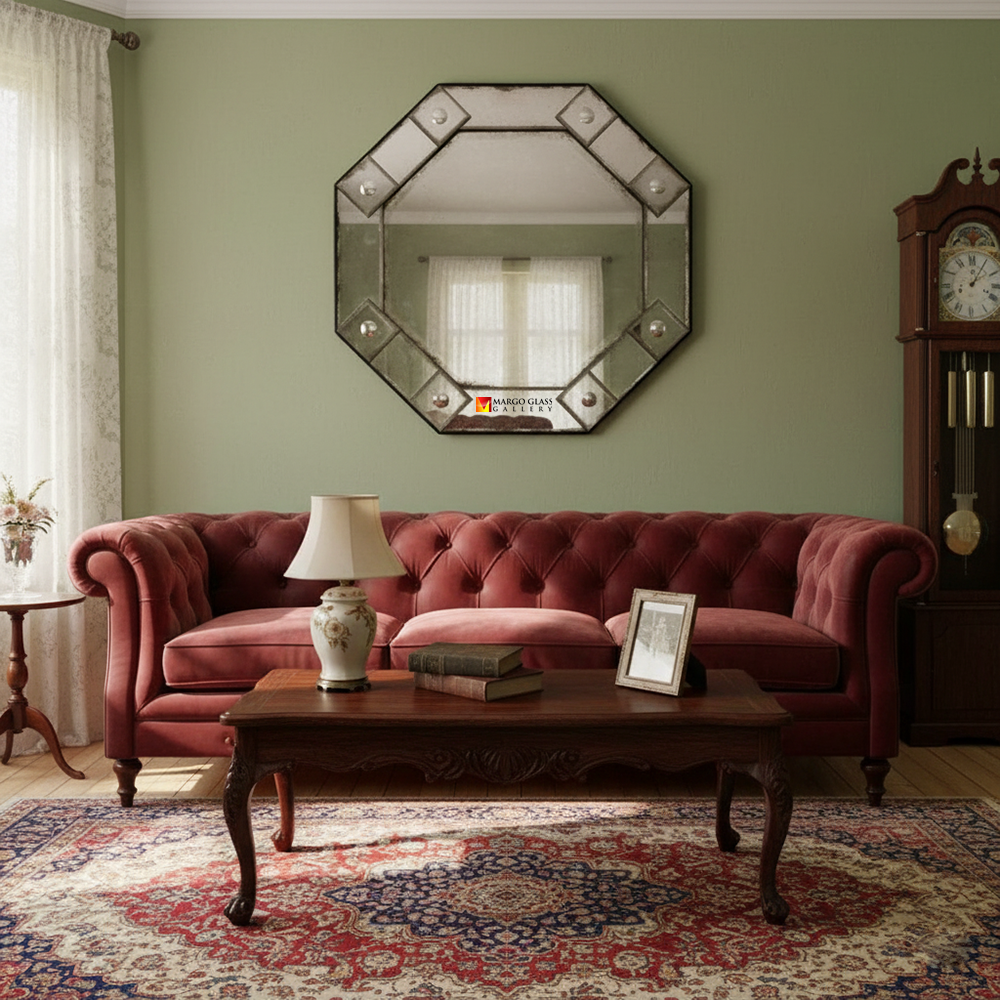
Mirrors serve as powerful mediums for representing this condition. An Antique Mirror Vintage does not merely record physical appearance; it evokes a psychological atmosphere that is reflective and introspective. It is a still object that carries a continuously moving layer of meaning.
The octagonal form has a long history in architecture and visual art. It frequently appears in sacred structures, transitional buildings, and spatial elements that signify change in function or status. The octagon exists between the circle symbolizing continuity and eternity and the square representing stability and structure. Is this merely coincidence, or the reason the form resonates so deeply on a psychological level?
Within the context of an Octagonal Antique Mirror, this symbolism is translated visually through balanced proportions and defined yet gentle angles. The shape conveys stability without rigidity a visual language of controlled transformation.
Octagonal mirrors are often positioned in transitional areas such as foyers, hallways, or spaces connecting public and private zones. As an Antique Wall Mirror, its presence reinforces the function of these areas as thresholds places where one prepares to enter or leave an experience.
With dimensions of 91 cm x 91 cm, the mirror is large enough to act as a focal point while remaining intimate. Its scale encourages personal interaction without overwhelming the surrounding space.
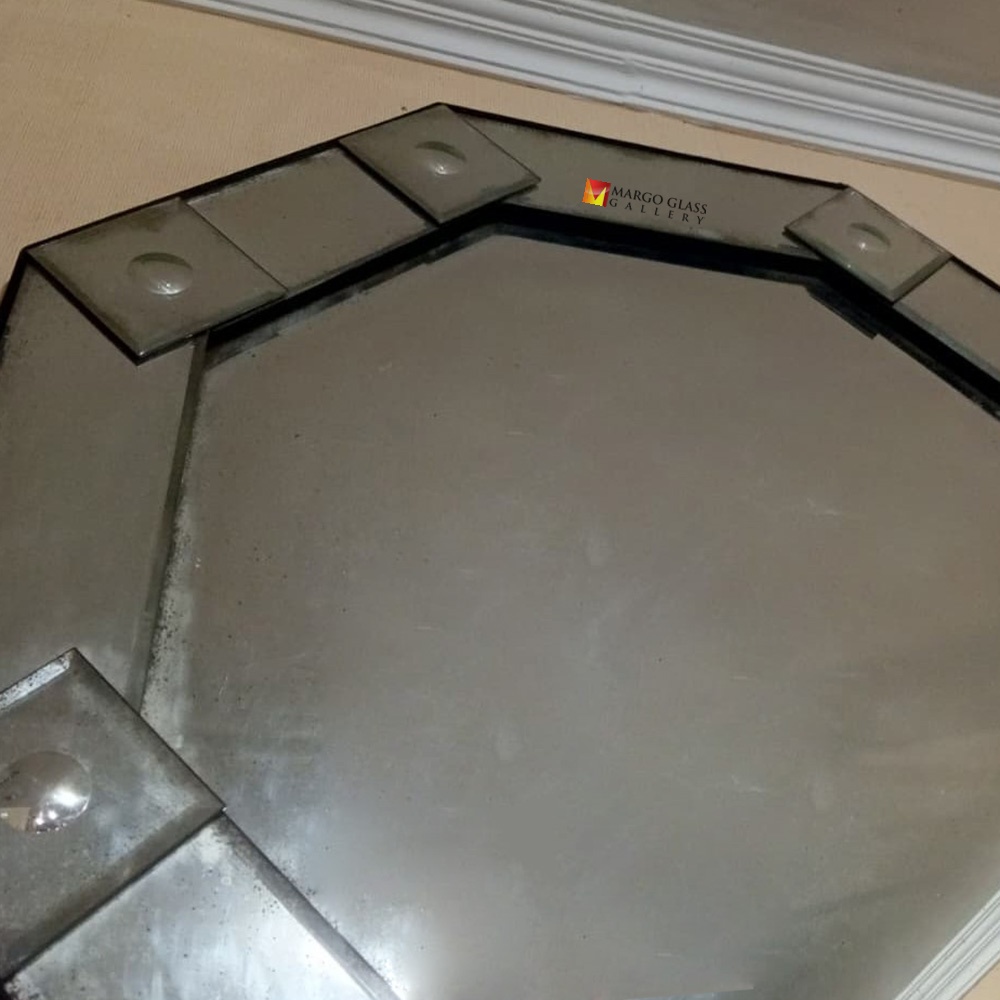
Mirrors inherently occupy an ambiguous position: they reveal but cannot be touched; they are real yet illusory. In visual culture, mirrors are liminal mediums by nature. When combined with antique characteristics, this meaning becomes even more pronounced.
Crafted from 5 mm thick glass with an antique effect, the reflection produced is intentionally non-sterile. Subtle speckling and soft silver-gray tones create visual depth that feels alive. This is the defining quality that distinguishes a Satin Antique Mirror from contemporary mirrors designed for absolute clarity.
Unlike modern mirrors that demand flawless sharpness, an Antique Mirror Vintage celebrates imperfection. Slight distortions in reflection invite contemplation. What are we truly seeing who we are today, or who we are in the process of becoming?
The back structure uses 18 mm plywood with a black finish, providing strength and stability. This dark backing acts as a quiet visual anchor, contrasting with the reflective surface a dialogue between permanence and transition.
The antique effect on the glass surface is not merely aesthetic; it functions as a visual language of time, memory, and shifting meaning. The gentle distortion of a Satin Antique Mirror slows the act of seeing, creating a contemplative experience. In moments of transition, isn’t this pause exactly what humans need to understand themselves more deeply?
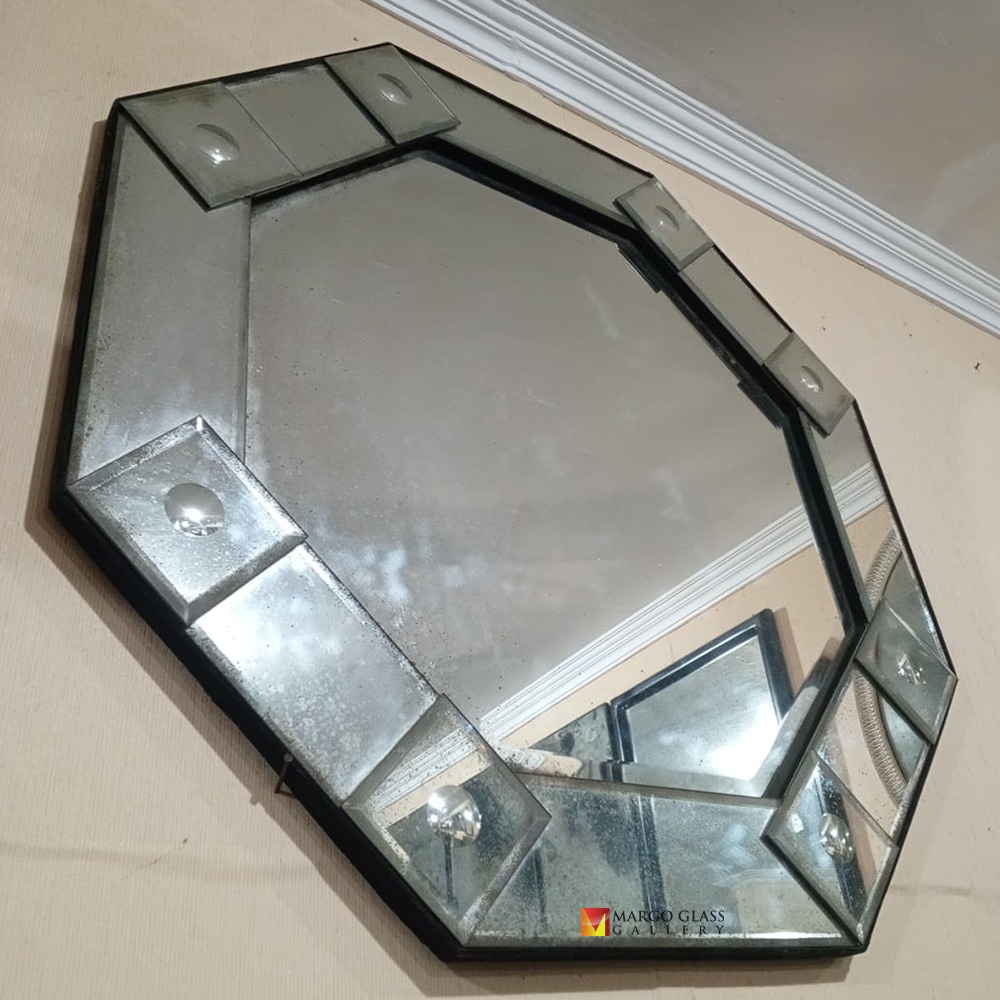
Contemporary visual culture is deeply shaped by nostalgia, ambiguity, and the search for identity. The octagonal antique mirror emerges as an object that bridges past and present. As an Antique Wall Mirror, it adapts seamlessly to a wide range of interiors from minimalist modern spaces to expressive artistic environments.
Is the growing attraction to liminal objects a reflection of modern society it self constantly suspended in the process of becoming?
Encountering one’s reflection through an Octagonal Antique Mirror is a distinct psychological experience. The mirror does not simply show a face; it evokes emotion quiet, reflective, and personal. Rather than offering immediate answers, it opens a dialogue with the self.
The octagonal antique mirror is more than a decorative object. It is a visual artifact of transition, identity, and time. Within each of its angles lies a narrative of being “in between” a condition profoundly relevant to contemporary life.
As an Antique Mirror Manufacturer, we believe that mirrors are more than tools for reflection. They are mediums that reflect human experience, cultural memory, and personal journeys. By choosing an octagonal antique mirror, you introduce not only visual beauty into a space, but also living meaning.
Is your space ready to participate in a visual dialogue about change and reflection?
By : Wulan
We are a leading manufacturer and wholesaler of Venetian mirrors in Indonesia. With our commitment to elegant design, superior quality, and competitive prices, we cater to individuals, wholesalers, and even large-scale projects such as hotels.
Whether you need advice on designs or sizes, feel free to consult with us. Let us be your reliable source for exquisite Venetian mirrors.