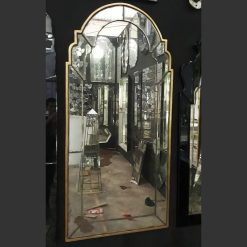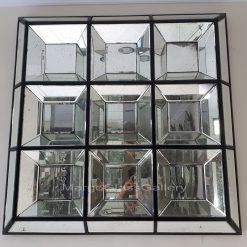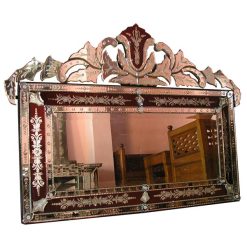
A Vertical Venetian Mirror within the Visual Language of the Renaissance never stands as a neutral object; it appears as a statement about how humanity understands the world. At the dawn of the Renaissance, worldview shifted from the symbolic mindset of the Middle Ages toward the belief that reality could be understood, measured, and ordered through reason.
Beauty was no longer seen purely as a divine mystery, but as the result of deliberate structure. It is here that the Venetian mirror emerges as a cultural object far beyond a reflective surface expressing symmetry, proportion, and order. Why is the Venetian mirror so aligned with Renaissance culture? Because it speaks the same language: the language of visual rationality, balance, and measured harmony.
The Renaissance marked the revival of classical Greco-Roman logic. Humanity was perceived as a thinking subject, capable of observing, reasoning, and structuring the world systematically. Within this context, visual objects architecture, painting, and furnishings became vehicles for expressing intellectual order.
An Aesthetic Venetian Mirror operates under the same principles: controlled lines, symmetrical composition, and ornamentation arranged not by chance, but through visual calculation. Can beauty exist without structure? For the Renaissance mind, the answer was unequivocal: no.
In the Renaissance era, symmetry was not merely an aesthetic concern, but a moral one. Visual balance was believed to reflect inner balance. When left and right ornaments correspond, when a central axis becomes the organizing force, a message emerges: order mirrors clarity of thought. A Carved Venetian Mirror with its repeated and symmetrical panels conveys this idea quietly. It does not shout; it instructs through order. Does a well-arranged space not often bring calm to the mind?
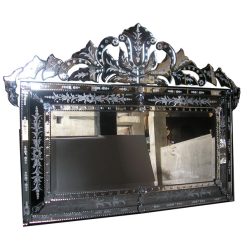
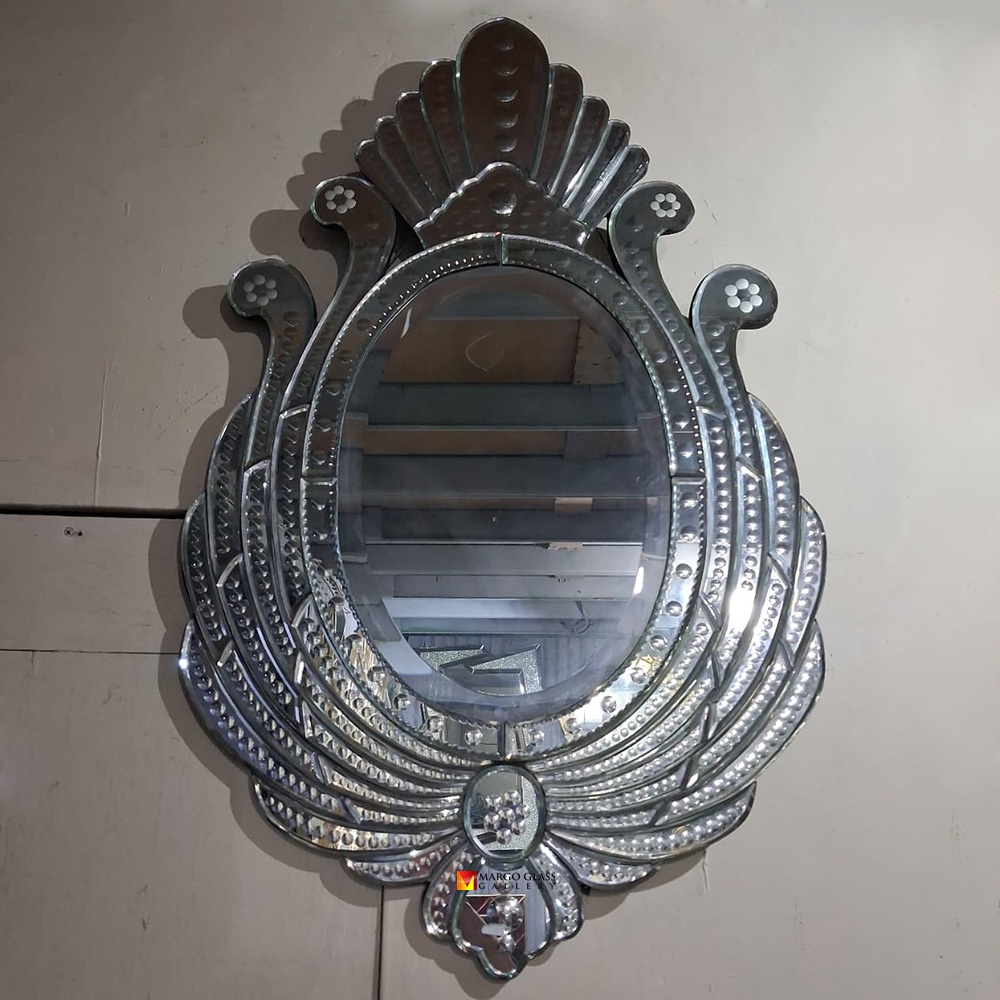
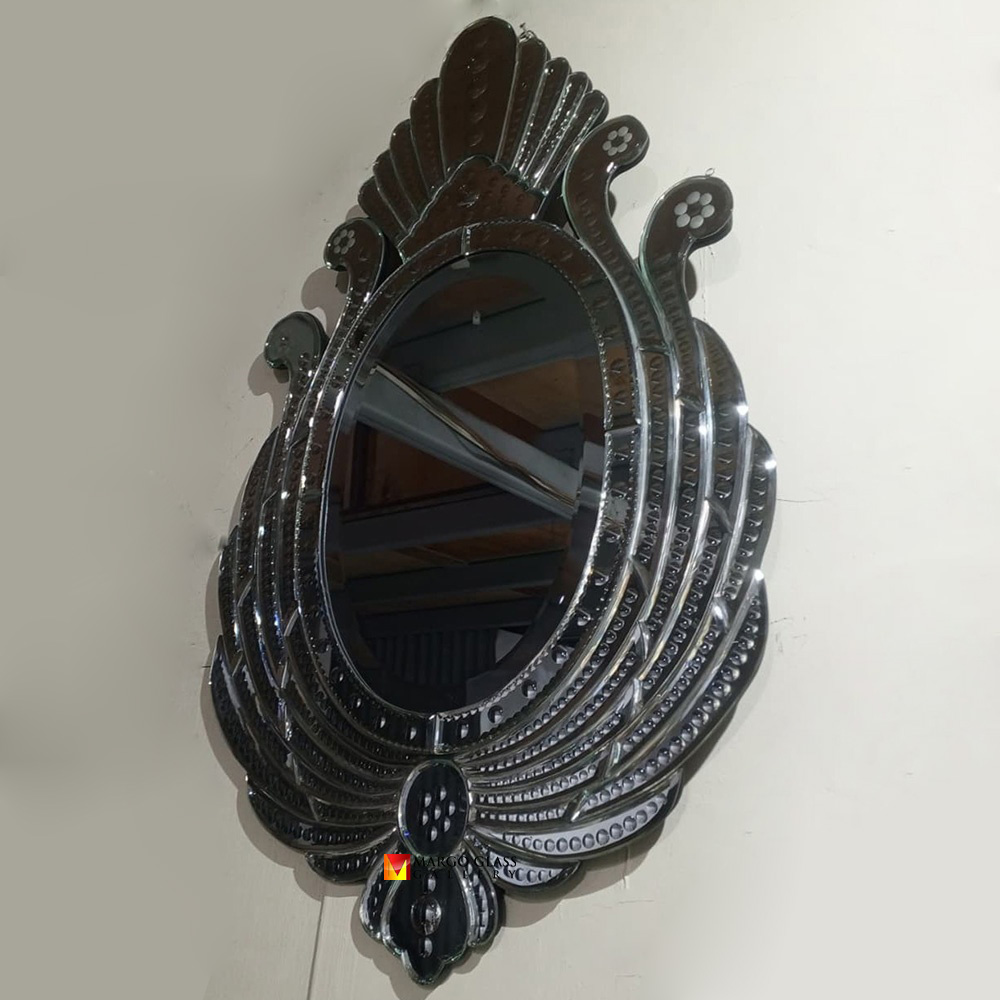
One defining characteristic of Renaissance art is layered ornamentation arranged hierarchically. In this Venetian mirror, the oval form at the center acts as the compositional core, surrounded by decorative glass layers that follow organic curves upward and downward. The bubble accents small rounded details encircling the mirror are not mere decoration; they establish a consistent visual rhythm.
Every layer has a role, every detail a place. This is how the Renaissance taught that complexity can remain orderly when guided by sound principles.
As an object, the Wisteria Venetian Mirror unites beauty with technical precision. The mirror is carved from the inside, resulting in a surface that remains smooth to the touch an approach reflecting meticulous craftsmanship and disciplined technique. A 5 mm thick mirror glass is used to ensure clarity and structural strength, while the beveled edges are carefully finished to prevent sharpness.
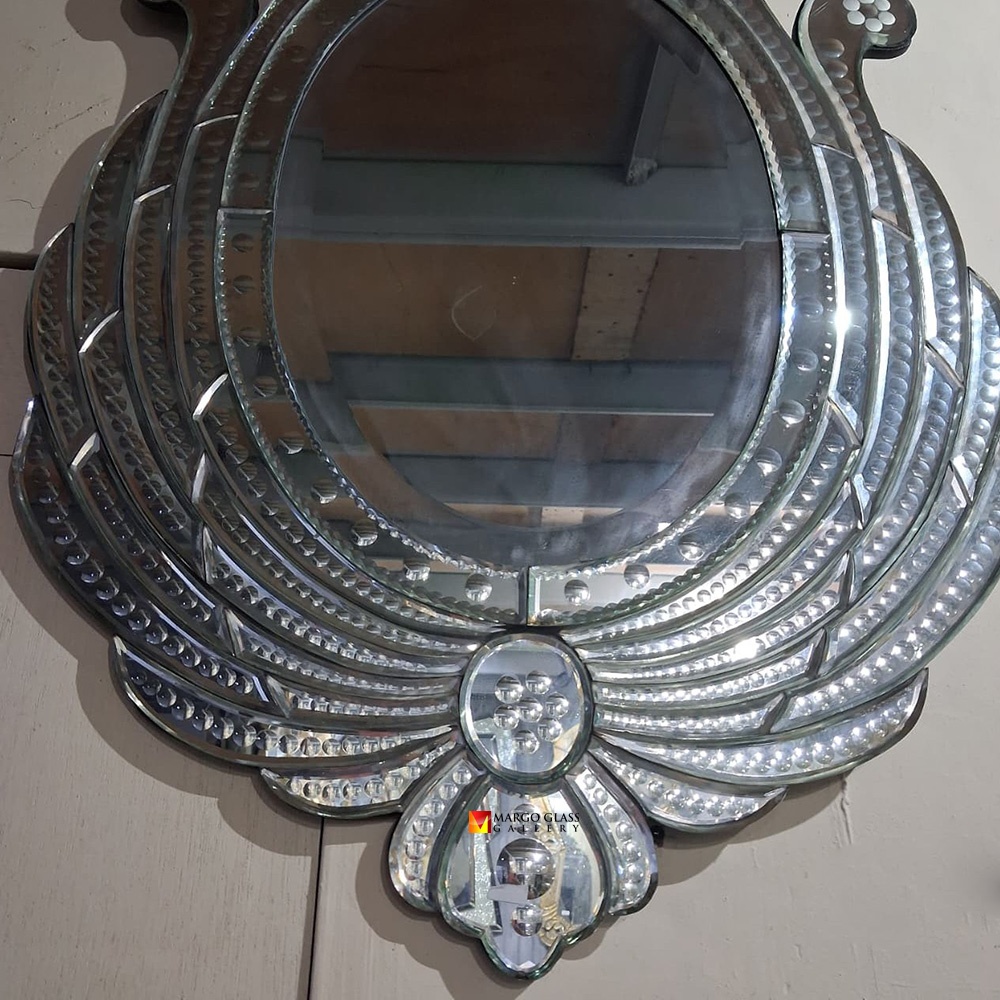
At the back, an 18 mm plywood frame with black finishing provides stability and a refined final appearance. Do such technical details matter? For Renaissance culture, this is precisely where rationality takes tangible form.
The mirror’s dimensions of 100 cm x 60 cm are not arbitrary. Its vertical proportion creates an elegant, elongated presence aligned with ideals of visual balance. Rhythm emerges through the repetition of glass panels and bubble accents encircling the frame, guiding the eye in an orderly flow. The classic silver tone reflects light softly rather than harshly, allowing it to blend effortlessly into various interiors.
In Renaissance principles, repetition is not monotony, but a method of achieving harmony. Is music not beautiful because of its rhythm?
During the Renaissance, mirrors were not common objects. They were often placed in representative spaces reception rooms, halls, or transitional areas as symbols of self-awareness and social order. Mirrors helped individuals perceive themselves within a structured environment. A Vertical Venetian Mirror carries this function into the present day: expanding light, organizing perspective, and signaling that a space is curated with aesthetic awareness.
Does a mirror merely reflect a face, or does it also reflect the values we live by?
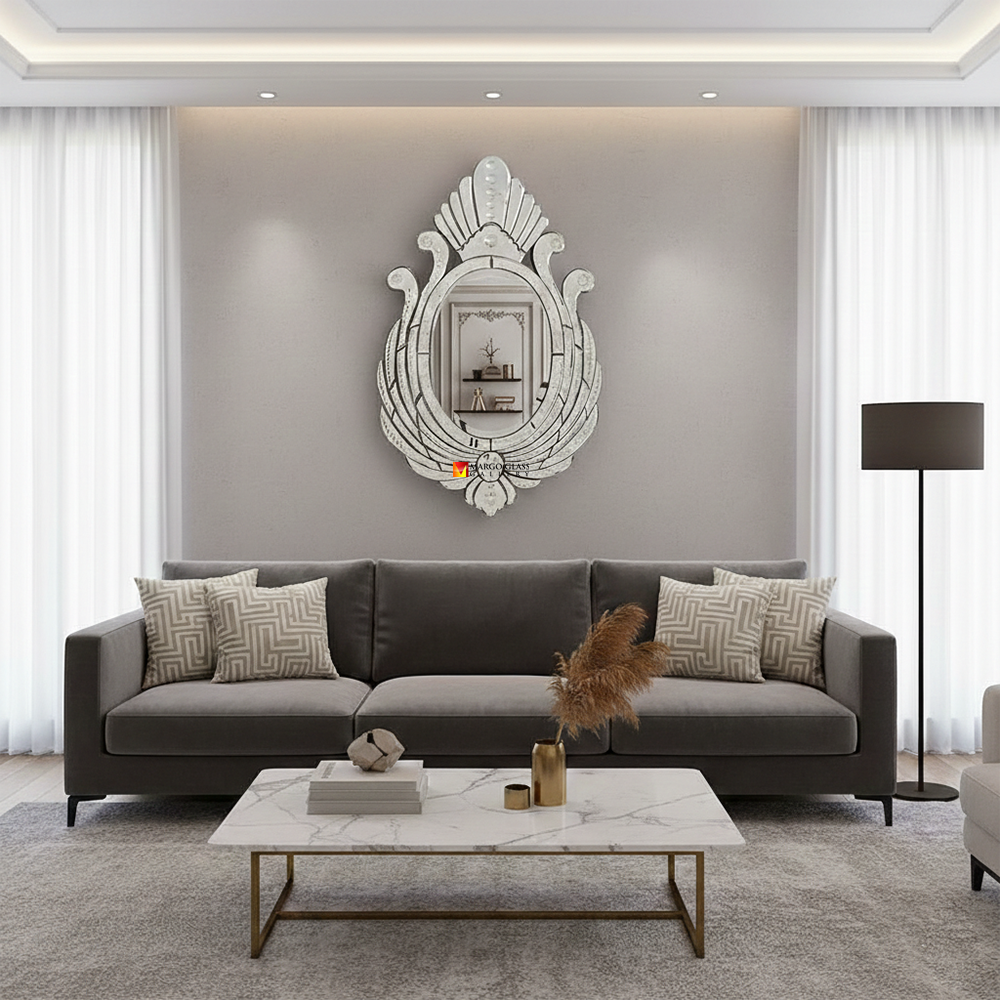
Today, the Venetian Wall Mirror is no longer confined to palaces or palazzi, yet its visual legacy endures with quiet authority. Within contemporary interiors, it functions as a bridge between past and present carrying Renaissance ideals of order, proportion, and symmetry into modern life. Its presence is not nostalgic, but intentional, reminding us that classical visual principles remain relevant even as styles and eras evolve.
When placed as a focal point, the mirror does not assert dominance over a space; instead, it brings clarity and structure. It organizes visual flow, balances surrounding elements, and anchors the room with a sense of composure. In doing so, it gently reminds us that beauty does not always arise from wild experimentation, but often from structures that are understood, refined, and respected over time.
The Venetian mirror teaches a lasting lesson: true beauty emerges from conscious order. From symmetry and proportion to precisely executed carvings, every element speaks of a visual rationality tested by time. If you seek an object that does more than enhance a space one that carries cultural and intellectual value this is the answer. With Venetian Mirror Company, discover a mirror that not only reflects light, but also reflects a great legacy of thought an invitation to bring order, calm, and enduring beauty into your space.
By : Wulan
We are a leading manufacturer and wholesaler of Venetian mirrors in Indonesia. With our commitment to elegant design, superior quality, and competitive prices, we cater to individuals, wholesalers, and even large-scale projects such as hotels.
Whether you need advice on designs or sizes, feel free to consult with us. Let us be your reliable source for exquisite Venetian mirrors.