Convex Antique Mirror has become an increasingly relevant visual element within heritage houses and adaptive reuse buildings spaces whose appeal lies in honest proportions, materials matured by time, and an atmosphere that cannot be replicated by modern construction. Yet behind their charm, these interiors present tangible challenges: narrow corridors, limited natural light, high ceilings that often feel visually empty, and conservation regulations that restrict structural intervention.
This raises an essential question: how can spatial perception be expanded without eroding historical character? Many contemporary visual solutions large frameless mirrors, seamless glass panels, or LED-based illusions often feel foreign and ahistorical when introduced into buildings that are decades or even centuries old.
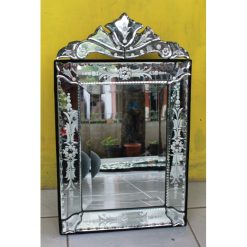
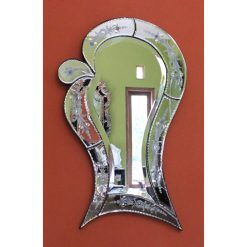
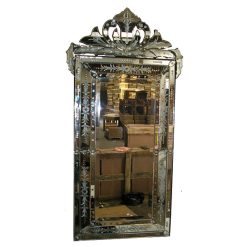
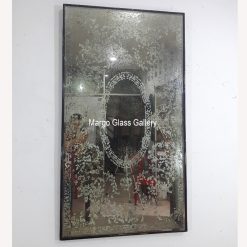
Antique convex mirrors offer a more civilized response. They are not modern tricks, but visual strategies rooted deeply in classical interior history. These three Convex Round Mirrors, each with a distinct antique character, provide a spatial expansion that resonates with the heritage spirit without denying age, texture, or material honesty.
Throughout European and colonial history, Convex Glass Mirror served purposes beyond simple reflection. It was used to oversee space, capture light, and widen visual perspectives in grand houses with long corridors. Its convex form allowed a single wall point to reflect an entire room, creating a sense of openness without overt manipulation.
These three mirrors inherit that legacy. Their balanced convex curvature produces a gentle distortion sufficient to expand spatial perception while preserving the visual calm required in heritage interiors.
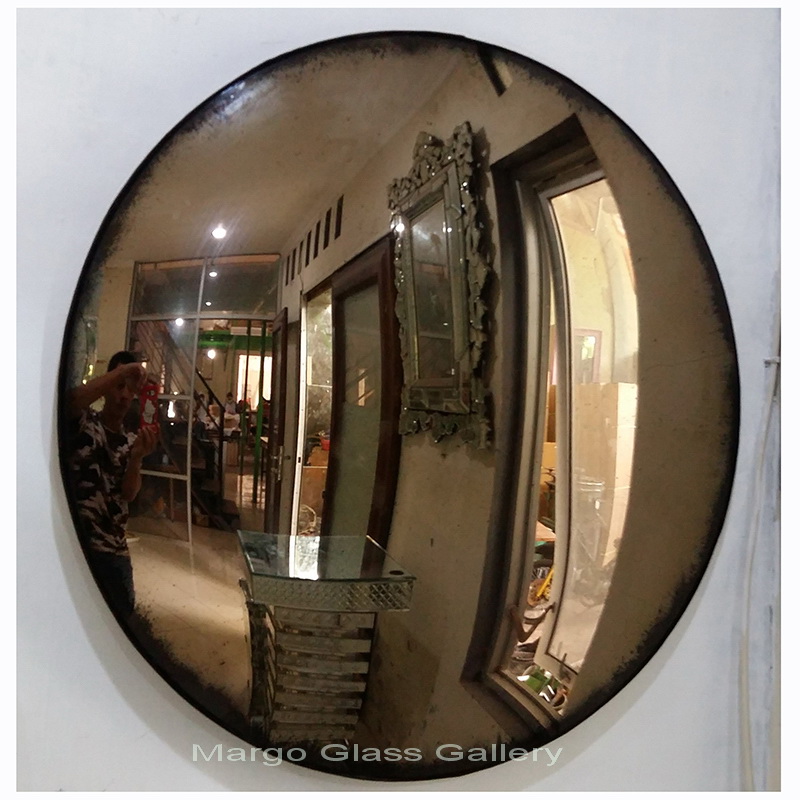
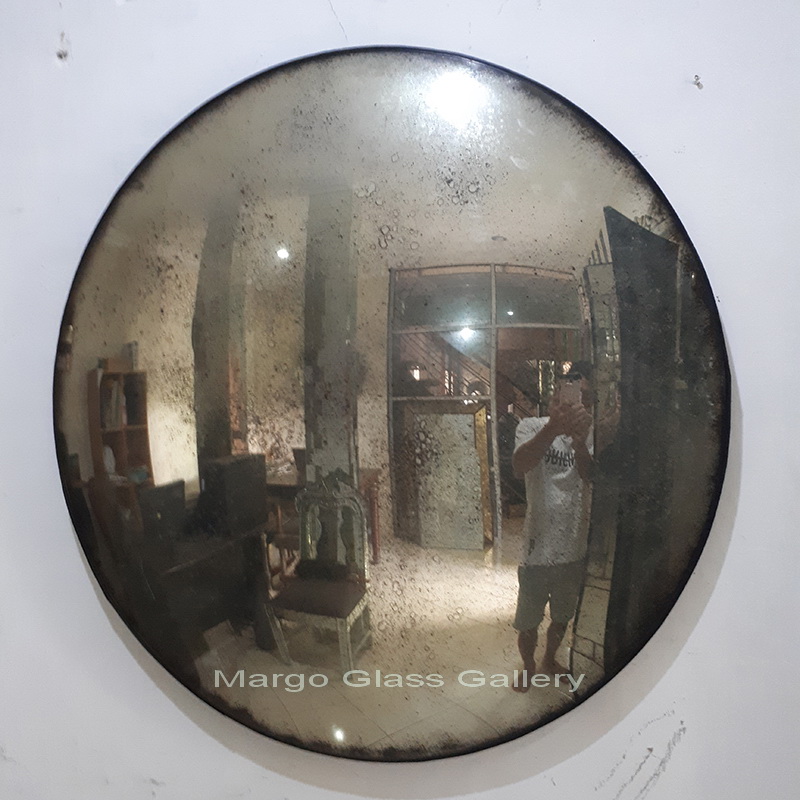
Unlike contemporary mirrors that appear clean, sharp, and assertive, Vintage Convex Mirrors operate with subtlety. The first mirror presents a smoky dark gradation with natural patina concentrated along the edges. Its reflection feels dramatic yet restrained ideal for colonial corridors or transitional spaces with limited lighting.
The second mirror features warmer brown-golden tones. Its aging effect is softer and more evenly distributed, making it well suited for heritage living rooms or colonial reception spaces that seek warmth without sacrificing elegance.
The third mirror displays the most expressive aging texture. Its visual distortion is stronger, allowing it to function as a statement object capable of filling tall walls without introducing additional ornamentation. Do heritage spaces not, after all, call for elements that tell stories rather than merely reflect?
In colonial homes and adaptive reuse buildings, the placement of a Convex Round Mirror is never arbitrary. Along long corridors, convex mirrors break linear narrowness. In rooms with high ceilings, they occupy visual voids without adding structural burden.
These three mirrors with generous diameters and 5 mm thick antique glass possess sufficient visual weight to stand independently. Their 18 mm plywood backing with black finish ensures structural solidity while maintaining a clean, discreet rear appearance. It is a solution that respects conservation principles while addressing contemporary functional needs.
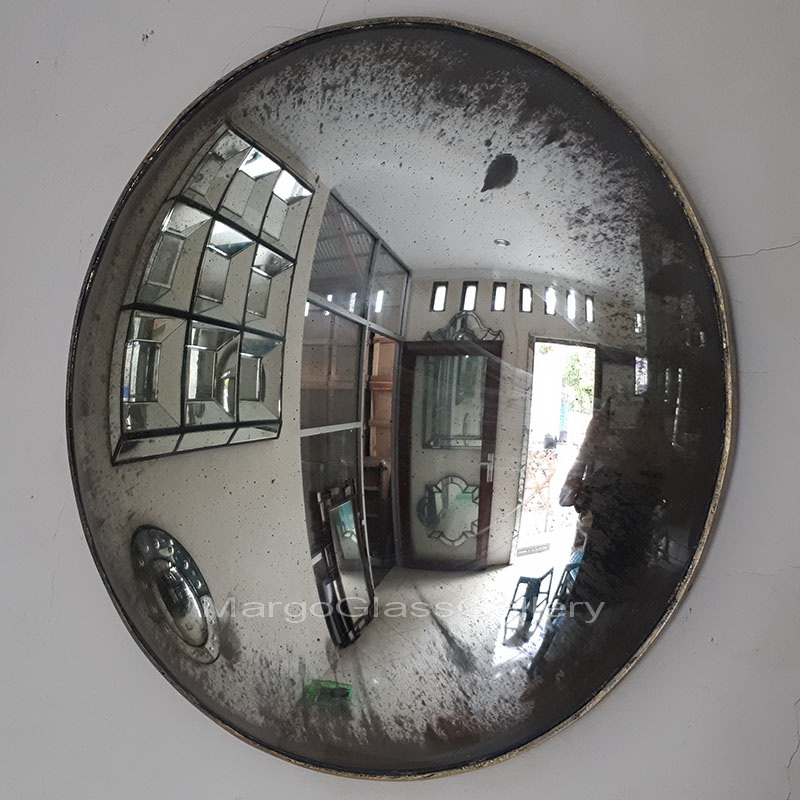
What makes a Convex Antique Mirror appropriate for heritage interiors is not merely its shape, but the integrity of its process. The antique effect on these mirrors is not designed to imitate age, but to express aging as a design language in itself.
Oxidation marks, tonal gradations, and surface imperfections engage in direct dialogue with aged walls, timber frames, terrazzo floors, or classic patterned tiles. In such spaces, perfection often feels suspicious. Do historic buildings not speak most clearly through their accumulated layers of time?
When paired with solid wood furniture, colonial cabinetry, or seating with patinated finishes, Vintage Convex Mirrors do not dominate they resonate. Dark-toned mirrors reinforce industrial-heritage character, while warmer variations harmonize with cream, brown, and deep green palettes common in tropical colonial interiors.
Mirrors with intense aging textures can even converse with rough elements such as exposed brick or aged plaster, creating spatial cohesion without excessive refinement.
Within a heritage context, convex mirrors should be treated as visual artifacts rather than decorative accents. These three mirrors with their serious construction and mature visual character are conceived as architectural components, not mere wall embellishments.
As a Convex Mirror Company, this approach positions the mirror not simply as a product, but as a cultural object one that understands the space it inhabits.
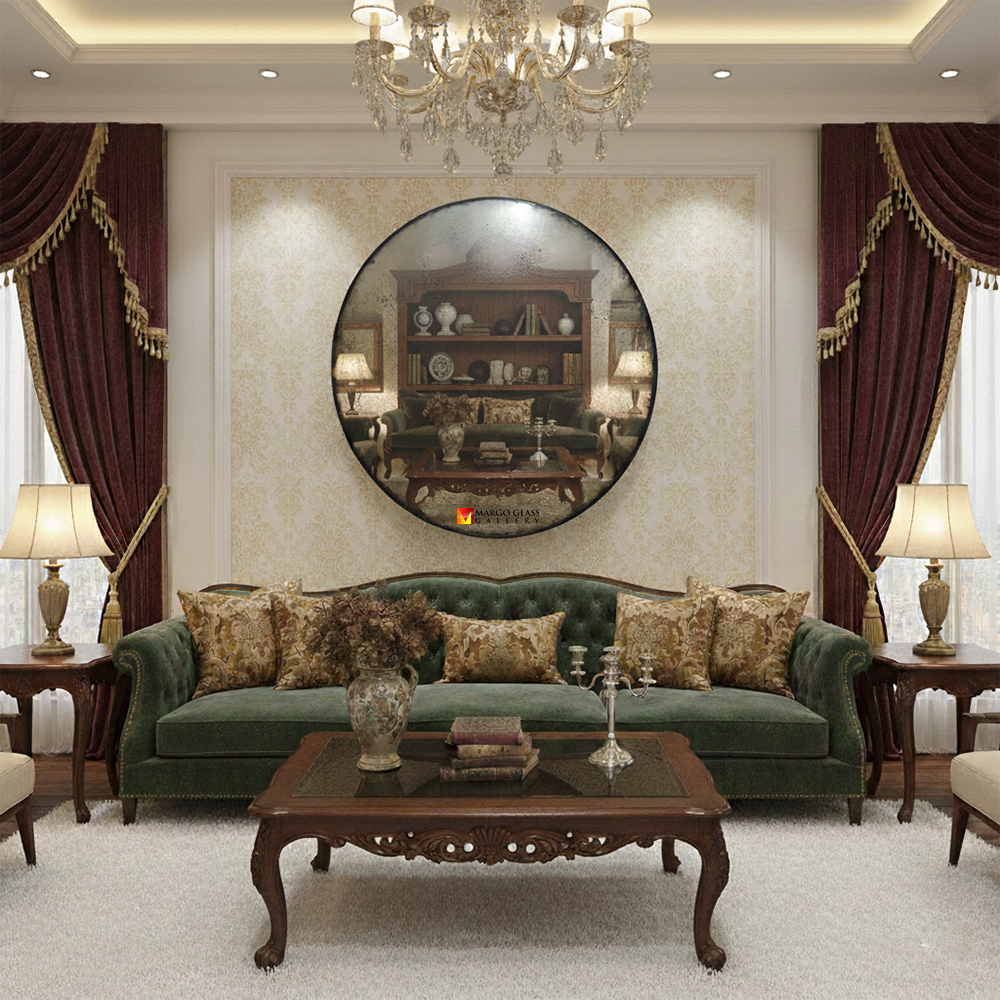
Imagine a colonial residence transformed into a gallery or boutique hotel. Along the corridor leading to guest rooms, a dark-patinated Convex Antique Mirror captures the entire spatial sequence. In communal areas, the warmer version fosters intimacy without diminishing historical presence. On the main staircase with soaring walls, the intensely aged mirror becomes a focal point that visually binds multiple levels together.
Is this a modern illusion or simply a continuation of a spatial language that has existed for generations?
Expanding space in heritage buildings is not about deceiving the eye, but about understanding visual history. Convex Glass Mirror with antique character offers an approach that is honest, mature, and contextually aware.
If you seek to expand space without compromising character, perhaps the answer lies not in new technology, but in historic forms reinterpreted with respect. As a Convex Mirror Company, we believe that historic spaces deserve solutions that honor their time.
Is your interior ready to speak in a more civilized way?
By : Wulan
We are a leading manufacturer and wholesaler of Venetian mirrors in Indonesia. With our commitment to elegant design, superior quality, and competitive prices, we cater to individuals, wholesalers, and even large-scale projects such as hotels.
Whether you need advice on designs or sizes, feel free to consult with us. Let us be your reliable source for exquisite Venetian mirrors.