Convex Wall Mirror, European cultural heritage in a tropical climate, is not merely a reflective object, but a historical trace that subtly adapted within the interiors of colonial homes across Asia and the Indonesian archipelago. Behind its curved surface lies a story of cultural encounter, technology, and climate.
Colonial houses left by the Dutch, British, and French in tropical regions did not simply transplant European styles, but reinterpreted them in response to intense sunlight, high humidity, and different spatial needs. Here, the interior became a space of cultural negotiation and the convex mirror emerged as a small element with profound meaning.
Why is the convex mirror so well suited to this context? Its curved form reflects light more broadly, allowing interiors to feel brighter and more spacious without excessive openings. In tropical climates, where ventilation and natural light are essential, the Convex Mirror Effect becomes both an aesthetic and functional solution. It is not merely decoration, but a visual instrument for managing space and light.
Convex mirrors have been known in Europe since the 16th century, particularly in the Netherlands and Italy. At that time, the technology required to produce curved glass symbolized progress and status. Convex mirrors were commonly found in aristocratic residences and public buildings, serving to expand visual perspective while subtly conveying luxury. When European powers expanded through colonialism, they carried this visual language into tropical regions, including Southeast Asia and the Indonesian archipelago.
In colonial contexts, Decorative Convex Mirror elements were no longer only symbols of status, but tools of adaptation. Their circular forms were gentle, non-dominant within space, and easily integrated with local architecture that emphasized openness and wide verandas.
Colonial houses in tropical regions faced challenges unknown in Europe: harsh sunlight, high humidity, and the need for maximum air circulation. Interiors were therefore designed with high ceilings, large openings, and reflective elements to help distribute light. Convex mirrors, with their dispersed reflections, helped interiors remain bright without introducing excessive heat.
In this context, material choice became essential. Mirrors made with 5 mm thick glass and an antique effect are not only durable, but also visually aligned with the age and character of colonial buildings. The 18 mm plywood backing with black finish provides structural stability while reinforcing a solid, grounded aesthetic a balance between function and colonial-era beauty.
Imagine a colonial living room with tiled floors, teak furniture, and thick light-colored walls. A round convex mirror hangs on the main wall, reflecting light from tall windows and expanding the room’s visual depth. Is this merely about beauty, or is a deeper spatial narrative being formed?
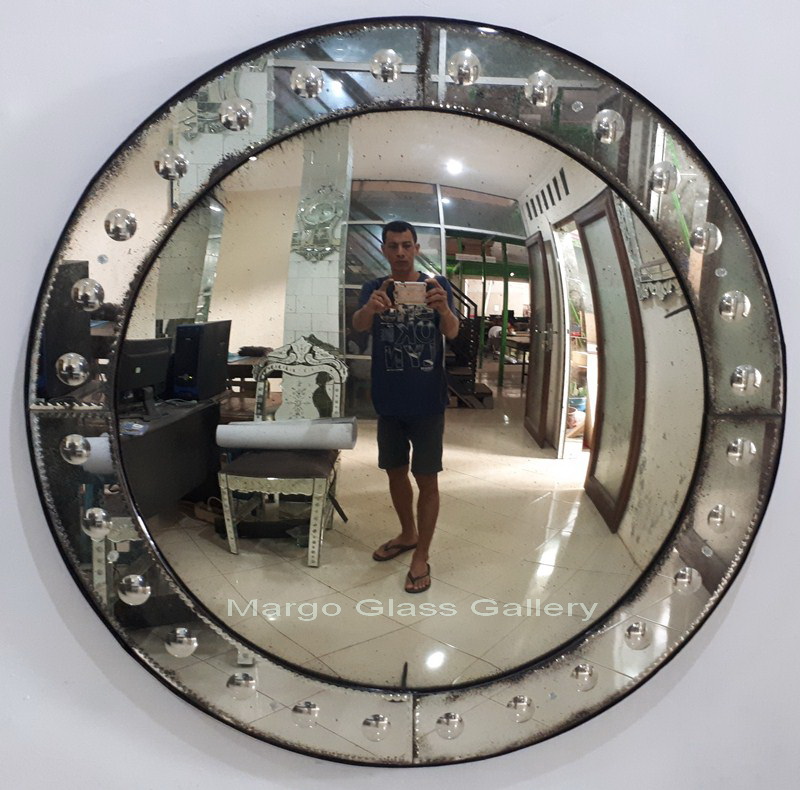
In one design, the convex mirror appears with antique glass panel framing and bubble accents surrounding its perimeter. The inner mirror itself uses a Convex Bubble Mirror, creating a lively, textured reflection. This design recalls early colonial interiors rich in ornamentation, making it ideal for representative spaces such as living rooms or foyers.
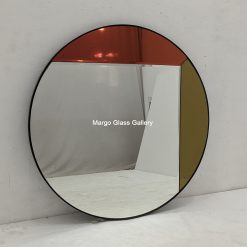
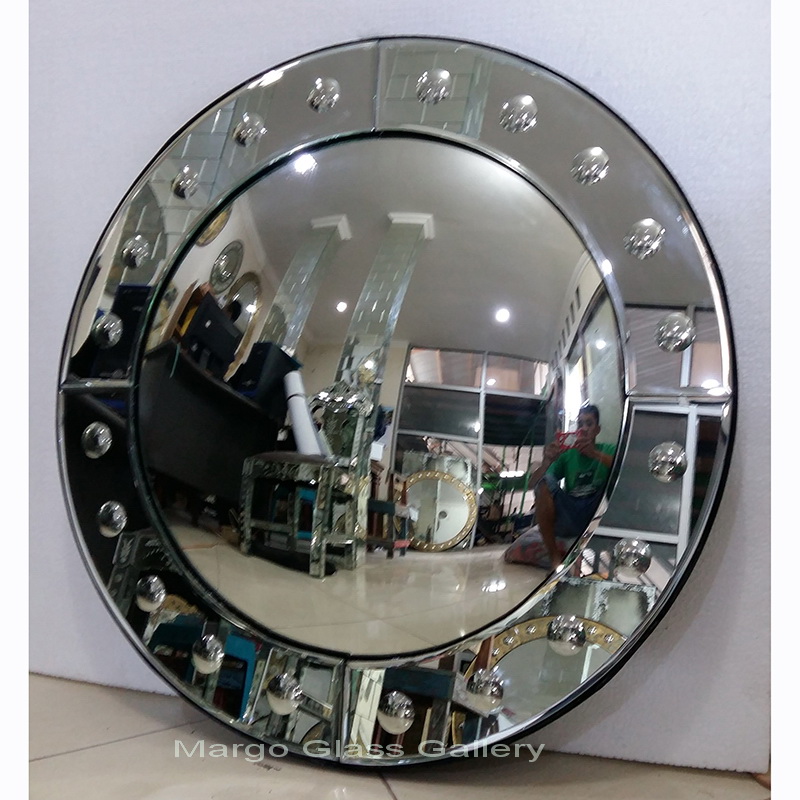
Another design adopts a calmer approach. The round form and antique glass panel framing remain, but the inner mirror is left plain. The reflection is clearer and more controlled, making it suitable for dining rooms or long corridors in colonial houses, where visual order is maintained.
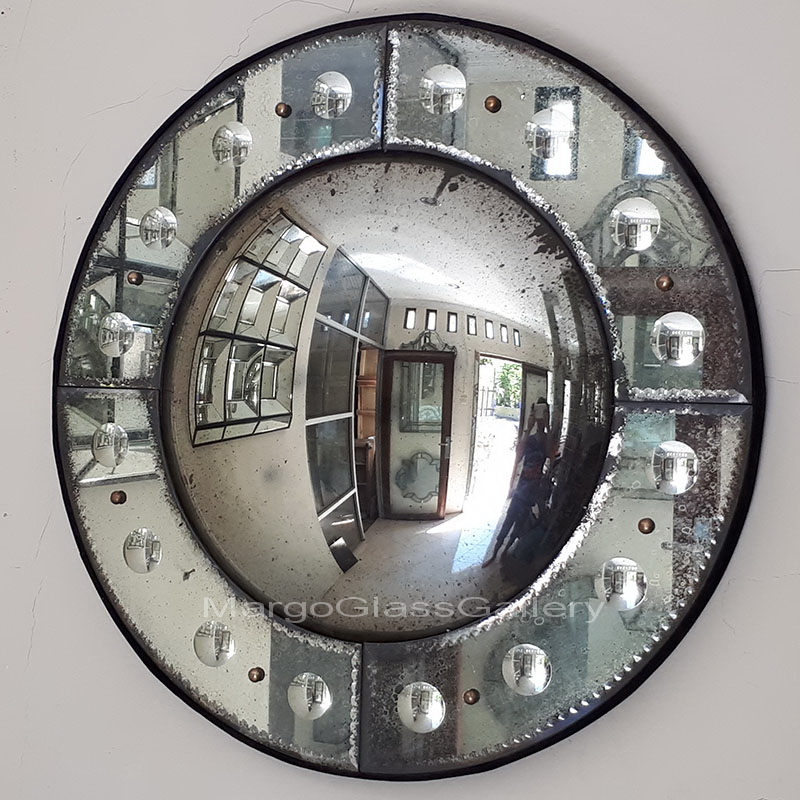
The third design presents a stronger antique character. The aging effect on the glass is more pronounced, combined with bubble detailing on the inner mirror, resulting in a deep heritage presence. This mirror feels almost like an artifact as if it has been part of the house for decades.
In colonial material culture, beauty often emerges from imperfection. Antique glass effects, oxidation speckles, and slightly irregular reflections give objects their soul. Convex mirrors with antique finishes are not new objects pretending to be old, but contemporary interpretations of colonial aesthetics.
Balanced proportions, full circular forms, and muted silvery tones allow these mirrors to blend effortlessly with tropical colonial interiors. Whether placed against whitewashed brick, wooden panels, or lime-plastered walls, their presence always feels natural.
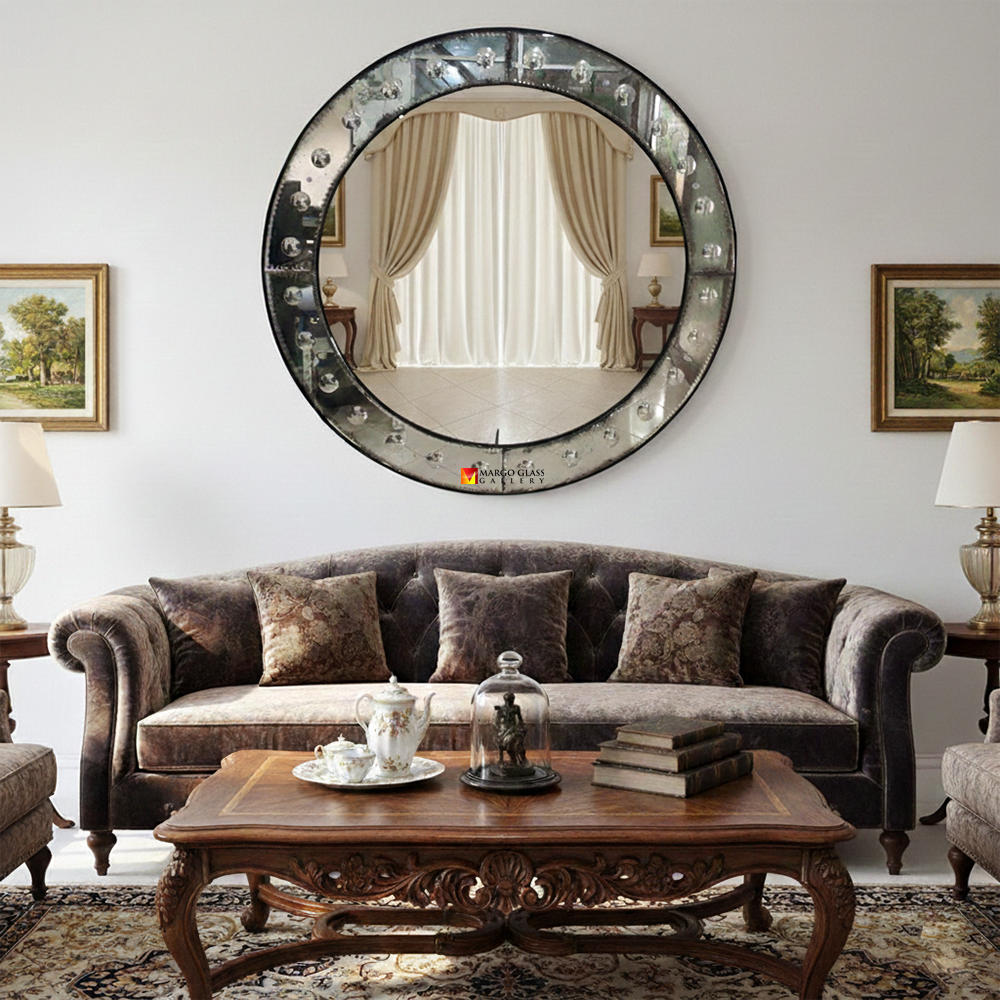
In the Indonesian archipelago, colonial houses often coexist with local elements carvings, rattan furniture, or more open spatial arrangements. Convex mirrors become visual bridges between Europe and the tropics. Their reflections capture light, greenery, and daily life, making interiors feel layered and alive.
It is no surprise that convex mirrors are experiencing renewed appreciation today, not only for heritage restorations but also for contemporary homes seeking to evoke a tropical colonial atmosphere.
Convex mirrors are most effective when placed opposite natural light sources: facing windows, at the ends of corridors, or within transitional spaces. In colonial homes, such placement preserves visual continuity and strengthens architectural character without excessive intervention.
Ultimately, a convex mirror is more than a mirror. It is a guardian of spatial narrative recording the interaction of light, architecture, and history. With the right materials, honest design, and cultural awareness, a Convex Wall Mirror becomes a living visual heritage.
As a Convex Mirror Supplier, we present convex mirrors crafted with 5 mm antique-effect glass and 18 mm plywood frames finished in black, designed to honor history while remaining relevant to contemporary interiors. Are you ready to bring the spirit of the tropical colonial home back into your space? Let these mirrors speak softly, reflectively, and full of stories.
By : Wulan
We are a leading manufacturer and wholesaler of Venetian mirrors in Indonesia. With our commitment to elegant design, superior quality, and competitive prices, we cater to individuals, wholesalers, and even large-scale projects such as hotels.
Whether you need advice on designs or sizes, feel free to consult with us. Let us be your reliable source for exquisite Venetian mirrors.